Indian Military Academy

वीरता और विवेक

Valour and Wisdom

The Indian Military Academy (IMA) is an officer training academy of the Indian Army located in Dehradun , Uttarakhand.  It was established in 1932 following a recommendation by a military committee set up under the chairmanship of Field Marshal Philip Chetwode. From a class of 40 male cadets in 1932, IMA now has a sanctioned capacity of 1,650. Cadets undergo a training course varying between 3 and 16 months depending on entry criteria. On completion of the course at IMA cadets are permanently commissioned into the army as Lieutenants.

The Academy, spread over 1,400 acres (5.7 km2), houses the Chetwode Hall, Khetarpal Auditorium, Somnath Stadium, Salaria Aquatic Centre, Hoshiar Singh Gymnasium and other facilities that facilitate the training of cadets. Cadets in IMA are organized into aregiment with four battalionsof four companies each. The Academy’s mission, to train future military leaders of the Indian Army, goes hand in hand with the character building enshrined in the IMA honour code, warrior code and motto. Cadets take part in a variety of sports, adventure activities, physical training, drills, weapons training and leadership development activities.

The Academy’s alumni include six recipients of India’s highest military decoration, the Param Vir Chakra, and India’s first Field Marshal Sam Manekshaw. Other achievements by alumni include 73 Military Crosses, 17 Ashoka Chakras, 84 Maha Vir Chakras and 41 Kirti Chakras. In 2017, Lieutenant Ummer Fayaz Parray was the 847th name to be engraved on the IMA War Memorial, which honours alumni of the Academy who have fallen in the course of action.
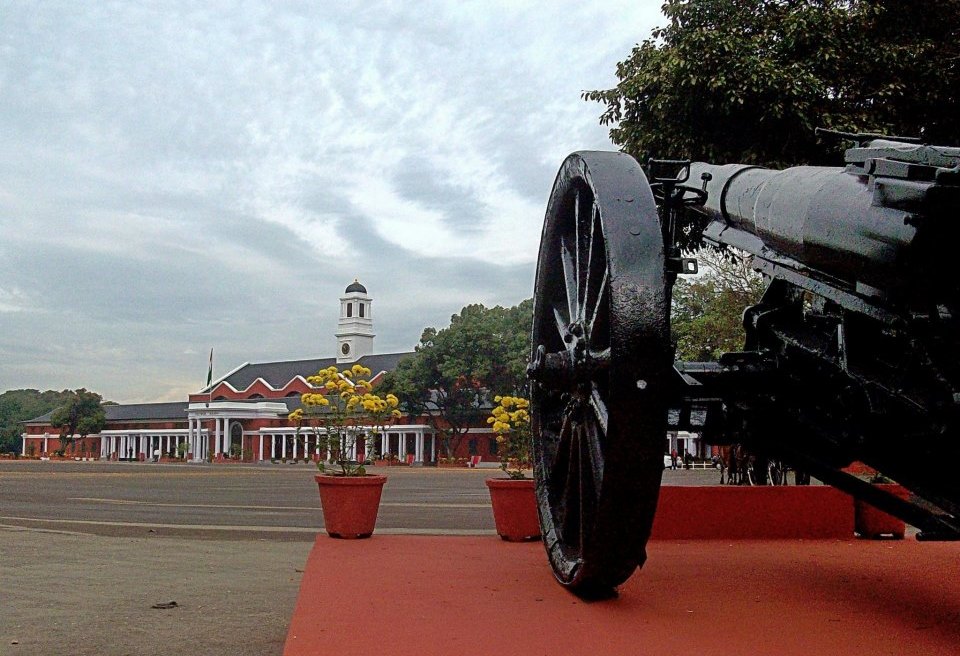
The main ground of IMA with Chetwode Hall and the drill square visible.

Campus

The Academy is located in the Doon Valley (Dronacharya Ashram), Uttarakhand. National Highway 72, the Dehradun–Chakrata Road, separates the North and South Campus. The campus of the Academy covers an area of 1,400 acres (5.7 km2). The Chetwode Hall on the drill square, built in 1930, houses the administrative headquarters of IMA and is also the hub of academic training. It has lecture halls, computer labs and a cafe. On the opposite side of the drill square is the Khetarpal Auditorium. Opened in 1982, it has a seating capacity of over 1,500. A newer wing of the Chetwode building, added in 1938, houses the central library. It has over 100,000 volumes and subscriptions to hundreds of periodicals from across the world, in addition to multimedia sections. In addition, there are two branch libraries closer to the cadet barracks across the campus.

The IMA museum on the campus displays artifacts of historic importance such as the pistol of Lieutenant General Amir Abdullah Khan Niazi of the Pakistan Army, given upon his surrender to Lt. Gen Jagjit Singh Aurora after signing the instrument of surrender to end the Bangladesh liberation war of 1971. A captured Pakistan Army Patton tank is also on the grounds.

Athletic facilities

The South Campus of IMA includes facilities such as the Somnath Stadium, with a seating capacity of 3,000, the Salaria Aquatic Centre, consisting of an Olympic sized swimming pool, and the Hoshiar Singh Gymnasium. The North Campus includes the polo ground along the Tons River. Tons Valley to the northwest of the campus is used for para-dropping, para-gliding, skydiving and battle training. Other facilities include stables with a stud farm, a small arms shooting range, and épée fencing from the modern pentathlon.

War Memorial

The IMA War Memorial commemorates the alumni of the Academy who died in action. At the sanctum sanctorum of the memorial is a bronze statue of a gentleman cadet with a sword presenting arms. The memorial was inaugurated by Field Marshal Manekshaw on 17 November 1999, shortly after the conclusion of the Kargil War. IMA officers led and fought in the war, with some of them becoming household names in India for their gallantry. Among their ranks were two Param Vir Chakra recipients and eight Maha Vir Chakra recipients. In 2017, Lieutenant Ummer Fayaz Parray was the 847th name to be engraved on the War Memorial.

Gentleman cadet life

There are various modes of entry into IMA, which include: on graduation from National Defence Academy, on graduation from Army Cadet College (a wing of IMA itself), direct entry through the Combined Defence Services Examination followed by SSB exams, and technical entry under university and college schemes. While those who gain entry into IMA go on to become permanently commissioned officers, those who go to the other officer training academies such as Officer Training Academy, Chennai are trained for short service commission. Depending on entry criteria married or unmarried male candidates are allowed to voluntarily apply for the course. Lady Cadets are not inducted into the Indian Army through IMA, though there has been talk of the same. IMA has a sanctioned capacity of 1,650.

A trainee on admission to IMA is referred to as a gentleman cadet (GC). One reason for this is that the Academy expects its graduates to uphold the highest moral and ethical values. Inscribed in the oak paneling at the eastern entrance of the Chetwode Hall is the Academy’s credo, excerpted from the speech of Field Marshal Chetwode at the inauguration of the Academy in 1932.

The safety, honour and welfare of your country come first, always and every time.

The honour, welfare and comfort of the men you command come next.

Your own ease, comfort and safety come last, always and every time.

Field Marshal Philip Chetwode[

Training

Technical graduates, ex-NDA, ex-ACC and university entry cadets undergo training at IMA for one year. Direct entry cadets train for one and a half years while the Territorial Army officers course is three months. A gentleman cadet gets a stipend of ₹56,100 (US$790) per month for the duration of the course (as per the 7th pay commission).

IMA’s mission is to train future military leaders of the Indian Army. Physical training, drills, weapons training and leadership development form the focus of the training. Character building is embedded in the honour code of IMA “I shall not lie, steal or cheat, nor tolerate those who do so”. From the honour code came the adoption of “The Gentleman Cadet’s Resolve” and in turn the Credo, Honour Code and Resolve became the Academy Trishul for conduct of cadets. The “Warrior Code” of IMA which has been adopted from the “Bhagwat Gita“, the punch line of it being “I am a Warrior, fighting is my dharma;” also talks of compassion.

Training is broadly categorised into character building, service subjects and academic subjects. Service subjects give basic military knowledge up to the standard required for an infantry platoon commander. Academic subjects provide the cadet with a general education so as to enable a basic knowledge in professional subjects as well as enable cadets to clearly express themselves both verbally and in writing. In the early 1970s the service subjects to academic subjects ratio was 16:9 (64% service to 36% academic); this ratio was enhanced for technical graduates to a ratio of 83% service subjects and 27% academic subjects. Over time this ratio varied as per regular course entry or technical entry, and changed as terms were increased or decreased.

Passing out parade

One of the most well known traditions in the IMA is the passing out parade (POP). Before the cadets begin the POP, the band plays an aarti, allowing the cadets to pray to their respective gods.[82] Traditionally, the adjutant leads the parade, cracking a joke to lighten the atmosphere.Having senior officers present during the POP is a morale booster for the cadets. In 2019, the reviewing officer for the 136th parade was Lt. Gen. Cherish Mathson.

During the POP, a civilian dignitary may also make a speech, as was the case during the passing out parade in 1962 when the President Dr. Sarvepalli. Radhakrishnan addressed the cadets, and in 2007 when the Prime Minister Manmohan Singh did so. In 1982, during the golden jubilee, Prime Minister Indira Gandhi inspected the POP while in 1992, the President R. Venkataraman reviewed the diamond jubilee POP (winter term). In 2006, President APJ Abdul Kalam was the reviewing officer at the POP.Newly commissioned officers after the passing out parade in 2006 doing celebratory pushups.

The finale is the antim pag (final step), where cadets take the last step into Chetwode Hall. However the POP on 11 June 1961 was called off without the final step due to weather, the only instance where this has happened for a passing out batch. The tradition of cap-flinging during the passing out parade has a long past but it was replaced by the cadets doing celebratory pushups. The passing out also consists of traditions such as presentation of a “Sword of Honour” to the best GC. Notable recipients of the Sword of Honour include the current Chief of Defence Staff Bipin Rawat (in 1978) and the Olympian and union minister Col. Rajyavardhan Singh Rathore (in 1990)
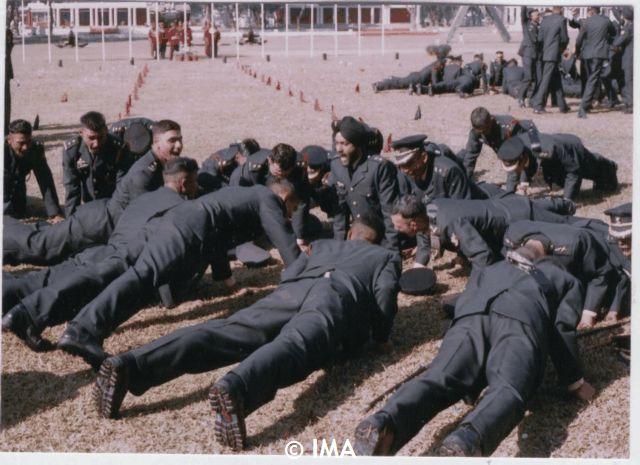
Newly commissioned officers after the passing out parade in 2006 doing celebratory pushups.
The President, Smt. Pratibha Devisingh Patil reviewing the Passing Out Parade Spring Term 2011, Indian Military Academy, at Dehradun, Uttarakhand on June 11, 2011.

Notable alumni

Over 61,000 GCs have graduated from IMA. IMA alumni have led and fought in every conflict in which the Indian Army has served. Numerous alumni have earned laurels, died in action and been honoured with gallantry awards. As of 2016, alumni from the Academy were recipients of 7 Param Vir Chakras, 17 Ashoka Chakras, 84 Maha Vir Chakras and 257 Vir Chakras. Alumni were also recipients of 2 Sarvattam Yudh Seva Medals, 28 Uttam Yudh Seva Medals, 48 Kirti Chakras and 191 Shaurya Chakras. Battle casualties from the Academy total 817 alumni.
National defence academy

सेवा परमो धर्मः

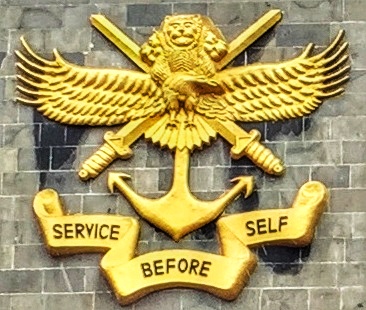
Service Before Self

The National Defence Academy (NDA) is the joint services academy of the Indian Armed Forces, where cadets of the three services, the Army, the Navy and the Air Force train together before they go on to respective service academy for further pre-commissioning training. The NDA is located in Khadakwasla, Pune, Maharashtra. It is the first tri-service academy in the world.

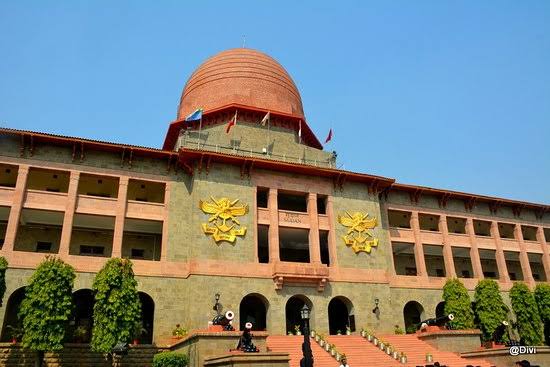
NDA Logo on the Sudan Building

The alumni of NDA include 3 Param Vir Chakra recipients and 12 Ashoka Chakra recipients. NDA has also produced 27 service Chiefs Of Staff till date. The current Chiefs of Staff of the Army, the Navy and the Air Force are all NDA alumni from the same course. The 137th course passed out on 30 November 2019, consisting of 188 Army cadets, 38 Naval cadets, 37 Air Force cadets and 20 cadets from friendly foreign countries.

History

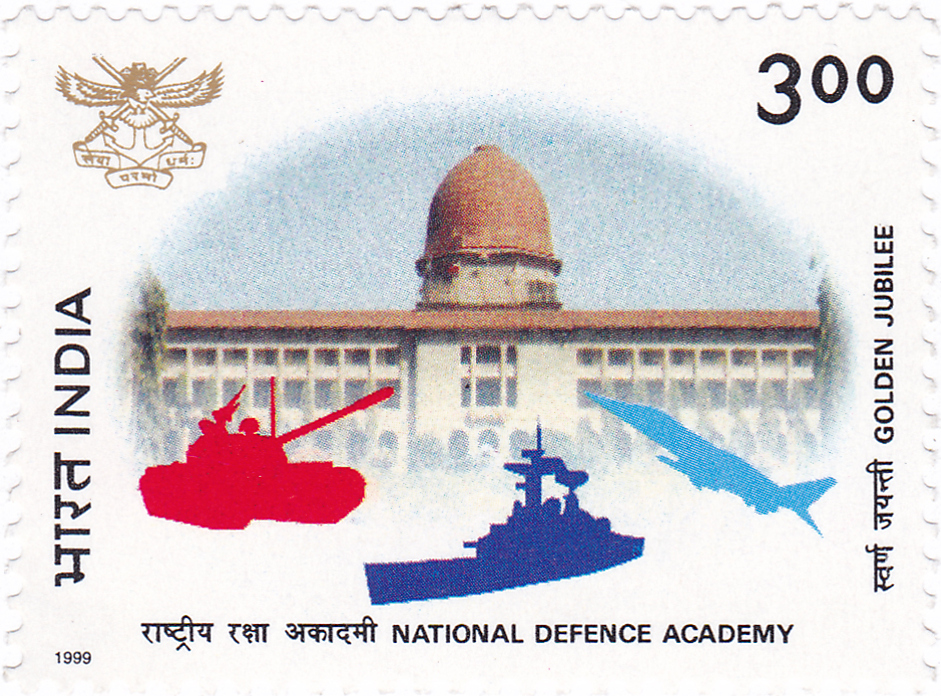
A 1999 stamp dedicated to the 50th anniversary of the National Defence Academy, featuring its Sudan Block

At the end of the World War II, Field Marshal Claude Auchinleck, then Commander-in-Chief of the Indian Army, drawing on experiences of the army during the war, led a committee around the world and submitted a report to the Government of India in December 1946. The committee recommended the establishment of a Joint Services Military Academy, with training modelled on the United States Military Academy at West Point.

After the independence of India in August 1947, the Chiefs of Staff Committee immediately implemented the recommendations of the Auchinleck report. The committee initiated an action plan in late 1947 to commission a permanent defence academy and began the search for a suitable site. It also decided to set up an interim training academy, known as the Joint Services Wing (JSW), which was commissioned on 1 January 1949 at the Armed Forces Academy (now known as the Indian Military Academy) in Dehradun. Initially, after two years of training at the JSW, Army cadets went on to the Military wing of the Armed Forces Academy for two years of further pre-commission training, while the Navy and Air Force cadets were sent to Britannia Royal Naval College Dartmouth and Royal Air Force College Cranwell in the United Kingdom for further training.

In 1941, Lord Linlithgow, then Viceroy of India received a gift of £100,000 from a grateful Sudanese Government towards building a war memorial in recognition of the sacrifices of Indian troops in the liberation of Sudan in the East African Campaign during World War II. Following partition, India’s share amounted to £70,000 (Rs 14 Lakh at the time; the remaining £30,000 went to Pakistan). The Indian Army decided to use these funds to partly cover the cost of construction of the NDA. The foundation stone for the academy was laid by then Prime Minister of IndiaJawaharlal Nehru on 6 October 1949. The total original estimate of the cost of construction of the National Defence Academy, Khadakvasala is 87 crores. It was it was started October 1949.  The original and the revised estimated costs for the whole project are Rs. 5 87 and Rs, 6 45 crores res­pectively. The increase of Rs. 58 lakhs is due to various reasons but principally because of a substantial rise in prices of materials and labour. 

The National Defence Academy was formally commissioned on 7 December 1954, with an inauguration ceremony held on 16 January 1955. The 10th JSW program was transferred from Clement Town, Dehradun to NDA Khadakwasla.

Campus

The NDA campus is located about 17 km south-west of Pune city, north-west of Khadakwasla Lake. It spans 7,015 acres (28.39 km2) of the 8,022 acres (32.46 km2) donated by the Government of the former Bombay State. While many states had offered land for a permanent place for the Academy, Bombay got the honour, donating the most land including a lake and neighbouring hilly terrain. The site was also chosen for its proximity to the Arabian Sea and other military establishments, an operational air base nearby at Lohegaon as well as the salubrious climate. The existence of an old combined-forces training centre and a disused mock landing ship, HMS Angostura, on the north bank of the Khadakwasla lake which had been used to train troops for amphibious landings, lent additional leverage for the selection of the site.Aptly, NDA is also located in the hunting grounds of the legendary Chhatrapati Shivaji Maharaj, with the Sinhagad Fort as a panoramic backdrop.

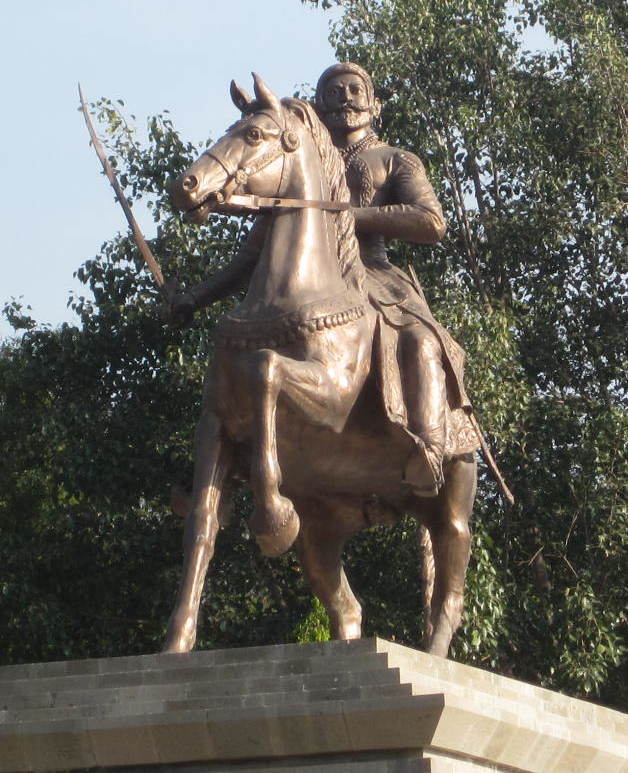
Shivaji memorial at the National Defence Academy .The 17th century Maratha warrior king is considered as the Father of Indian Navy.

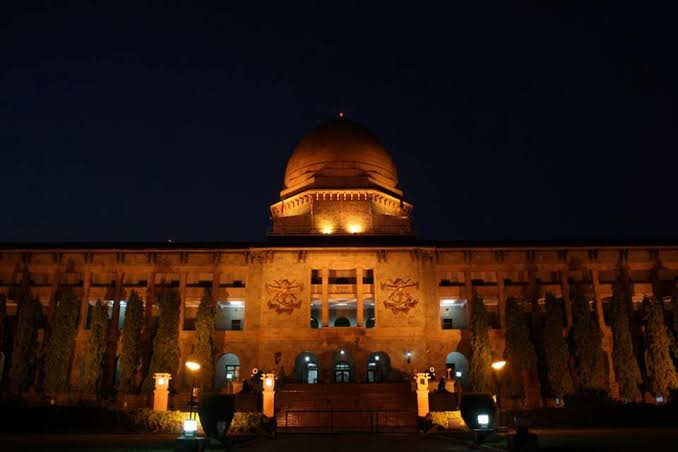
The administrative headquarters of the NDA was named the Sudan Block, in honour of the sacrifices of Indian soldiers in the Sudan theatre during the East African Campaign. It was inaugurated by then Ambassador of Sudan to India, Rahmatullah Abdulla, on 30 May 1959.The building is a 3-storey basalt and granite structure constructed with Jodhpur red sandstone. Its architecture features an exterior design comprising a blend of arches, pillars and verandahs, topped by a dome. The foyer has white Italian marble flooring and panelling on the interior walls. The Habibullah Museum is also present on the campus.

NDA has an excellent infrastructure for all-round training of cadets and a vast array of facilities like spacious and well-maintained classrooms, well-equipped labs, two Olympic size swimming pools, a gymnasium, 32 football fields, 2 polo grounds, a cricket stadium and a number of squash and tennis courts.The academic year is divided into two terms, viz. Spring (Jan. to May) and Autumn (July to Dec.). A cadet must undergo training for a total of six terms before graduating from the NDA.

Administration

Commandants

The Commandant of the National Defence Academy is the head and overall in-charge of the academy. The Commandant is a Three-star rank officer from the three Services in rotation.Major General Thakur Mahadeo Singh, DSO was the first commandant of JSW at IMA. Major General E Habibullah was the last head of the JSW and the First Commandant of NDA at Pune. Air Marshal I. P. Vipin, VM is the present commandant. Lt Gen Jatinder Singh, the twenty eighth commandant, was accused in a recruitment scandal and removed from his post for corruption.

Admission Process

Applicants to the NDA are selected via a written exam conducted by the UPSC, followed by extensive interviews by the SSB covering general aptitudepsychological testing, team skills as well as physical and social skills, along with medical tests. Incoming classes are accepted twice a year for semesters starting in July and January. About 4,50,000 applicants sit for each written exam every year. Typically, about 6,300 of these are invited to interview. The minimum age should be 16 and half years and maximum age should be 19 and half years. The number of students who were admitted to the Joint Services Wing Of the National Defense Aca­demy during 1953-54 is 572. Total application received in UPSC 6,061. 

Applicants who join the Air Force through the flying branch also go through a test called Computerized Pilot Selection System or CPSS for short. About 340 cadets are accepted to the academy each semester. About 90 cadets are accepted for the Air Force, 42 for the Navy and 208 for the Army.

Cadets who are accepted and successfully complete the program are sent to their respective training academies for one year of training before granting of commission: army cadets go to Indian Military Academy (IMA) at Dehradun, air force cadets to Air Force Academy (AFA) at DundigalHyderabad, and naval cadets to Indian Naval Academy (INA) at EzhimalaKerala.

Squadrons and Battalions

A cadet is allotted to one of the 18 Squadrons. The Squadrons are named as Alpha, Bravo, Charlie, Delta, Echo, Foxtrot, Golf, Hunter, India, Juliet, Kilo, Lima, Mike, November, Oscar, Panther, Quebec and Romeo. No. 1, No. 2, No. 3 and No. 4 Battalions have four squadrons each while No. 5 has 2 squadrons. Each squadron has approximately 100 to 120 cadets drawn from senior as well as junior courses under training in the Academy.

Passing out

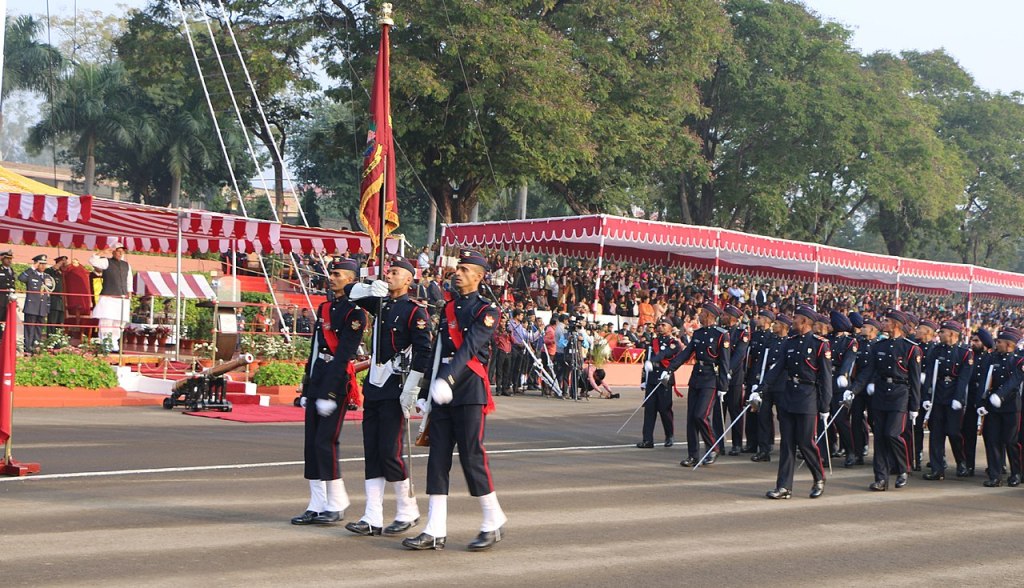
On 30 November 2019, the passing-out parade of the 137th course of the Academy was held with 284 cadets graduating. Defence Minister Rajnath Singh was the chief guest for the occasion.

Passing Out Parade at the National Defence Academy on 30 November 2019.

Curriculum

Academics

The NDA offers only a full-time, residential undergraduate programme. Cadets are awarded a Baccalaureate degree (a Bachelor of Arts or a Bachelor of Science) after 3 years of study. Cadets have a choice of two streams of study. The Science stream offers studies in PhysicsChemistryMathematics and Computer Science. The Humanities (Liberal Arts) stream offers studies in HistoryEconomicsPolitical ScienceGeography and Languages.

In both streams, academic studies are split into three categories.

Cadets spend the first four semesters on the Compulsory Course and the Foundation Course. They take the Optional Course during the fifth and sixth semesters. They may transfer to other Service academies for the optional courses.

Training

All the cadets joining the NDA after their 10+2 Examination are trained in the Academy for three years culminating in graduation with BA(or)BSc or BCs (Computer Science) degree of Jawaharlal Nehru University; the first course to be awarded degrees was the 46th course in 1974. Apart from academic training they are also trained in outdoor skills, like DrillPT and games; apart from one of the foreign languages up to the lower B1 level (according to the international standards). The emphasis in NDA is on character buildingesprit-de-corps, mental and physical robustness, leadership and a sense of keen observation. Life in NDA is all about learning discipline and adhering self improvement.

Service training

Air Force

The Air Force Training Team (AFTT) aims at training Air Force cadets in the basics of military aviation through ground training and flying training. Ground training is conducted with the help of modern training aids, aircraft models, and cross-sectional models of aero-engines and instruments, Radio Telephony simulators and Flight simulators. Flying training consists of a minimum of eight sorties on the Super Dimona aircraft. Cadets also get an exposure to deflection firing through Skeet shooting. Visits to key Air Force training establishments, Air Force Stations and civil aviation centers are also undertaken to give cadets first – hand experience of aviation activities. Visits to Air Force Academy, Air Wing at Indian Armament Technology, Air Base at Pune and College of Military Engineering are organised to enable the Air Force cadets to appreciate the Air Force aspects. Flying training at the AFTT is fully backed by an Automatic Weather Station, Air Traffic Control Station, a paved runway and a dispersal for six aircraft.

The AFTT was formed towards the end of 1956. The aim of the AFTT is to introduce the VI Term cadets to gliding and allied professional subjects, which in turn prepares them for their professional training in the Air Force flying establishments. Over the last 60 years, the gliding training has evolved into flying training. Five different classes of gliders were acquired by the Academy since 1957. They are Sedberg T-21B, Baby Eon, Eon OlympicaRohini and Ardhra gliders. All these gliders with the exception of the Baby Eon and Eon Olympics were utilised in the flying training of the cadets.

The Sedberg T-21B was the mainstay of the AFTT in glider flying with each cadet being permitted a total of 60 training launches, after which 2-3 mandatory Solo Check launches were flown with the Chief Flying Instructor (CFI). Cadets cleared for solo flying flew one solo trip on the glider and were then formally awarded their ‘Wings’, exactly half the size of the official Indian Air Force wings, which were worn above the left shirt pocket of their formal uniforms. Sandbags were used as ballast in place of the absent instructor.

The cadet who went solo with the lowest number of launches was usually awarded the Best In Gliding Trophy on the Guest Dining-in Night, one night prior to the Passing Out Parade. The Air Force cadet who stood first in Ground Subjects was awarded the Sqn Ldr Vasudev Memorial Book Prize that same night.

The induction of Super Dimona in 2001 is a watershed moment in the history of AFTT introducing a huge jump in the quality of training. A gliderdrome having a 950 m (3,120 ft) long runway is maintained within the premises of the NDA by the AFTT. The Air Force cadets of the academy learn the basics of gliding and powered flight at this facility on the Diamond HK36 Super Dimona gliders.

Army

Cadet are imparted a blend of outdoor and indoor training. Outdoor training is carried out in the hilly and wooded terrain in and around the NDA campus. Indoor training includes theoretical and practical simulated training. Cadets are taught subjects such as tactical training, weapon training, map reading, military writing, field engineering, organisation and administration and radio telephony. Training visits to operational military establishments and bases are also incorporated to enhance the practical content of the training.

During his stay at the NDA, an Army cadet is taught judging distances, terrain study, indication and recognition of targets, camouflage and concealment, trench digging, observation by day and night, stalking, organisation of an Infantry section, section formations, field signals and fire control orders. They are also taught handling of firearms, marksmanship and night firing. In addition, aspects of NBC Warfare and CI ops are also taught to the cadets.

An Inter Squadron Bayonet fighting competition is held to inculcate a spirit of aggression and martial hue as also to teach the nuances of hand-to-hand combat. An Inter Squadron Firing Competition is also conducted to enhance levels of marksmanship and night firing skills.

Camp Green Horn is conducted to introduce a second term cadet to the basic battle subjects such as map reading, tent pitching, fitting of web equipment, navigation, endurance training, compass reading and development of leadership qualities. Camp Rover is conducted to introduce a fourth term cadet to the basic battle subjects.

In the sixth term Camp Torna, “recalling the first victory of Shivaji, a teenager” is conducted, where practical aspects are reinforced in simulated field conditions. The cadets are provided with opportunities to demonstrate leadership qualities in various tactical situations. Other aspects covered during the camp include navigation by day and night, quick attack at section level, patrolling, ambush, endurance training, and occupation of a Section Defended Post and conduct of a defensive battle at section level by night.

Navy

The Naval Training Team (NTT) is the oldest of the Training Teams at the NDA. The main task of the Naval Training Team is to train V and VI term naval cadets on Specialist Service Subjects both theoretical and practical. Naval cadets on completion of their 3 years of training go to Indian Naval Academy (INA) as their finishing academy for 1 year, where they commence their M.Sc degree along with cadets of INA who will be doing B.Tech. From 2015 army and air force cadets get naval training as well.

The major emphasis is laid on Navigation, Seamanship and Communication. A total of 328 theoretical classes are conducted for VI term naval cadets. Theoretical instructions are imparted in the class room at NTT and Peacock Bay by using modern teaching methodology where-in 3D modelsComputer Assisted Instruction (CAI) and Computer Based Training (CBT) packages, scaled down models are used. Practical instructions are imparted in the Watermanship Training Centre at Peacock bay during regular periods and during club days. TS Ronnie Pereira, the in-house scale model of a warship helps in imparting training.

In order to orient the cadets to the navy, an orientation visit to Mumbai is conducted prior to the commencement of service training; during which the cadets visit various class of ships, submarines, shop floors, repair facilities etc. As part of the visit the naval cadets are sent to NBCD School to acquaint with fire fighting, damage control aspects. Further, to inculcate competitive spirit and adventurism amongst the cadets, VI term naval cadets are sent to Naval Academy, Ezhimala to take part in Open Sea Whaler Sailing Expedition and interact with their counterparts at the INA.

Camp Varuna during the middle of the term to get a first hand experience onboard during sailing and Camp Varuna II at the end of the term to put the theoretical knowledge acquired at NTT into practical use during the three days sailing. Watermanship Training Centre includes Yachting, Kayaking, Windsurfing, Rowing, Water-skiing, Ship Modeling.